Description
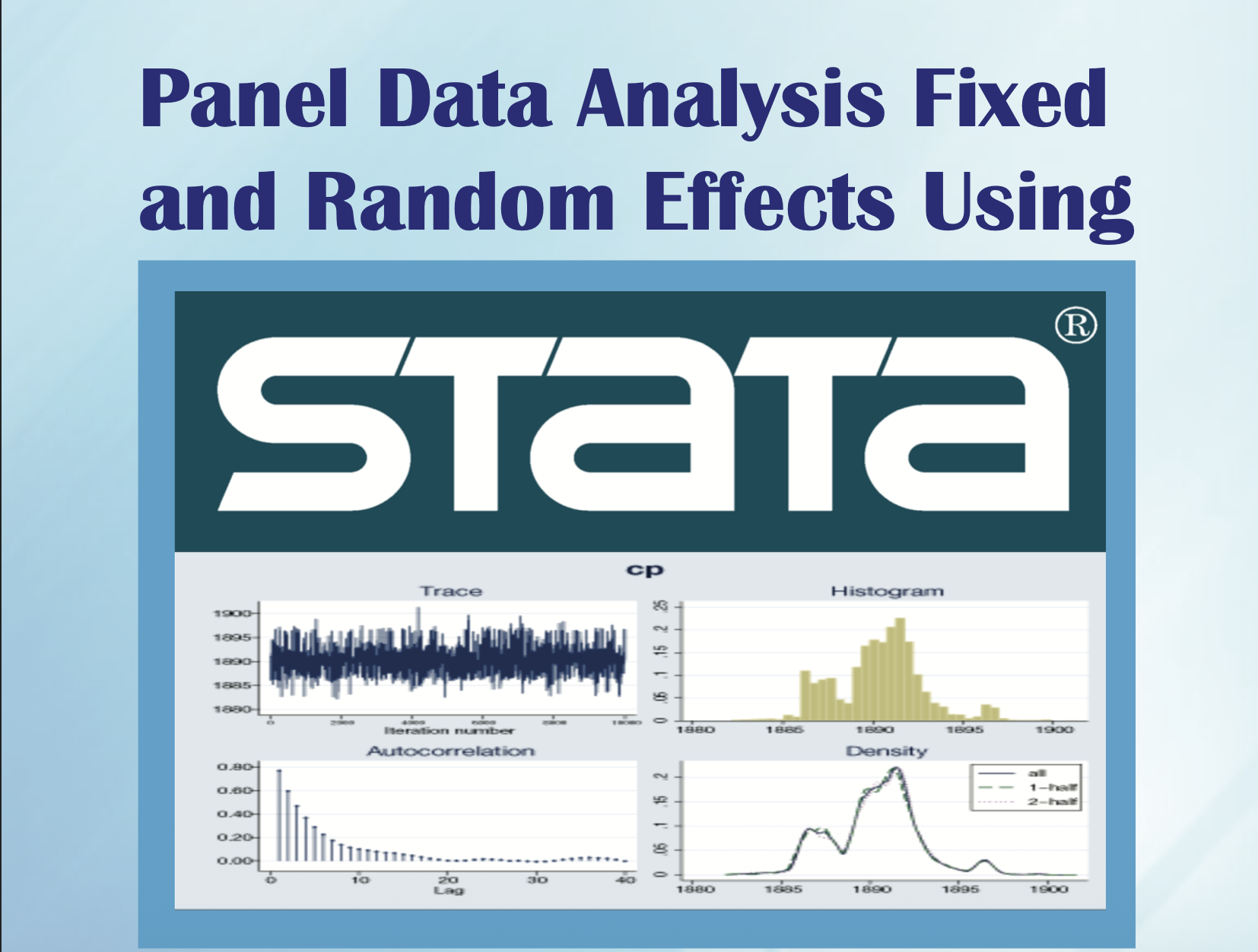
Are you struggling to run panel data analysis in Stata? Do you know how to collect panel data but feel stuck when it comes to choosing between fixed effects and random effects — or understanding what to do with the Hausman test result? This Panel Data Analysis Guide by Tobit Research Consulting Ltd is your complete, practical reference for mastering panel data methods in Stata, from declaring your panel structure to running and interpreting every major diagnostic test your examiner or supervisor will expect.
Written in plain, step-by-step language with annotated Stata output and real command examples, this guide takes you from raw panel data all the way to publication-ready results — giving you the confidence to defend your methodology in any viva voce, proposal defence, or journal submission.
─────────────────────────────────
─────────────────────────────────
MODULE 1: INTRODUCTION TO PANEL DATA
✔ Understanding panel data — what it is, how it is structured, and why it is more powerful than cross-sectional or time-series data alone
✔ Declaring your panel in Stata using xtset — setting the entity variable and the time variable
✔ Handling balanced and unbalanced panels — what the difference means and how Stata treats each
✔ Fixing the common string variable error in xtset using encode
✔ Exploring panel data visually using xtline — separate and overlaid graphs
✔ Visualising heterogeneity across entities and across time before modelling
✔ Running and interpreting pooled OLS regression as a baseline comparison model
MODULE 2: FIXED EFFECTS MODEL
✔ The theory behind fixed effects — what within-entity variation means and why it matters
✔ When to use fixed effects and when it is the wrong choice
✔ The fixed effects equation — understanding αi, βXit, and uit
✔ Running fixed effects in Stata using xtreg, fe
✔ Reading and interpreting the full xtreg output — Prob > F, R-sq (within, between, overall), rho, corr(u_i, Xb), coefficients, standard errors, t-values, and p-values
✔ The Least Squares Dummy Variable (LSDV) approach using regress with i.entity
✔ Using areg with absorb() as a faster alternative for large datasets
✔ Comparing xtreg, regress, and areg output side by side using estimates table
✔ Adding time fixed effects to the entity fixed effects model (two-way fixed effects)
✔ Testing whether time fixed effects are needed using testparm i.year
✔ Understanding why fixed effects cannot estimate time-invariant variables
MODULE 3: RANDOM EFFECTS MODEL
✔ The theory behind random effects — between-entity and within-entity errors
✔ The key assumption distinguishing random from fixed effects — corr(u_i, X) = 0
✔ When to use random effects and what it allows that fixed effects cannot
✔ Running random effects in Stata using xtreg, re
✔ Reading and interpreting the random effects output — Wald chi², Prob > chi², rho, sigma_u, sigma_e
✔ Why random effects coefficients reflect both within-entity and between-entity variation
✔ Including time-invariant explanatory variables in the random effects model
MODULE 4: CHOOSING BETWEEN FIXED AND RANDOM EFFECTS
✔ The Hausman test — full step-by-step procedure in Stata
✔ Running xtreg, fe and xtreg, re, storing estimates with estimates store
✔ Executing hausman fixed random and reading the output
✔ Interpreting chi² and Prob > chi² — when to use fixed effects and when random effects is preferred
✔ What to do when the Hausman test fails to produce a positive definite statistic
✔ Making the model choice based on theory when statistical tests are inconclusive
MODULE 5: DIAGNOSTIC TESTS FOR PANEL DATA
✔ Breusch-Pagan Lagrange Multiplier (LM) Test — testing whether random effects is needed over simple OLS (xttest0)
✔ Modified Wald Test for groupwise heteroskedasticity in the fixed effects model (xttest3)
✔ Wooldridge Test for first-order serial correlation / autocorrelation in panel data (xtserial)
✔ Breusch-Pagan LM Test of independence for cross-sectional dependence (xttest2)
✔ Pesaran CD Test for cross-sectional dependence (xtcsd, pesaran)
✔ Unit root and stationarity tests for macro panels (xtunitroot — Levin-Lin-Chu, Im-Pesaran-Shin, Hadri LM)
✔ Selecting the right robust standard error correction — robust, cluster(), xtregar, xtgls, xtscc
✔ When each diagnostic test is necessary — macro vs micro panels, short vs long time series
─────────────────────────────────
─────────────────────────────────
✅ Masters and PhD students writing quantitative dissertations or theses in economics, finance, accounting, public policy, or the social sciences
✅ Postgraduate researchers working with repeated observations across firms, countries, households, or individuals
✅ Economists, financial analysts, and policy researchers analysing cross-country or firm-level panel datasets
✅ Lecturers and instructors who teach econometrics and quantitative research methods
✅ Anyone who has collected panel data and is not sure which model to run or how to interpret the output
✅ Researchers in Kenya and across Africa working with commercial bank data, household survey panels, or government administrative data
─────────────────────────────────
WHY THIS GUIDE STANDS OUT
─────────────────────────────────
★ Step-by-step Stata commands for every model — no prior econometrics programming experience required
★ Annotated output tables showing exactly what every number in the Stata results window means
★ Full coverage of both model theory and practical application — understand not just how to run the model but why you are running it and how to defend it
★ Covers the complete decision workflow — from xtset setup through model selection, estimation, diagnostics, and robust correction
★ Includes the Hausman test workflow that most textbooks skip or explain poorly
★ All five key diagnostic tests covered — heteroskedasticity, serial correlation, cross-sectional dependence, random effects vs OLS, and unit roots
★ Used by researchers and postgraduate students across Kenya and East Africa
★ Published by Tobit Research Consulting Ltd — a NITA-certified research consulting firm based in Nairobi with expertise across SPSS, Stata, EViews, R, and NVivo
★ Client Focused. Result Driven.
─────────────────────────────────
─────────────────────────────────
📄 Format: PDF (Digital Download)
🖥️ Software: Stata (compatible with Stata 11, 12, 13, 14, 15, 16, 17, 18)
🏢 Publisher: Tobit Research Consulting Ltd
📍 Based in: Nairobi, Kenya — serving researchers across Africa and beyond




Reviews
There are no reviews yet.